
COUNTING CARDS
Session Summary
Appraisal goes here.
Running Count Summary
Running Count bars for each hand with Profit/Loss line overlaid.
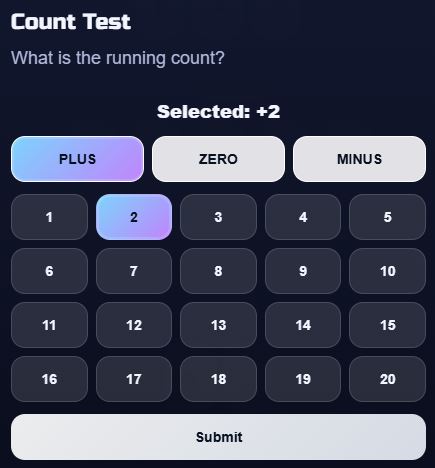
Count Test
What is the running count?
Beat The Dealer: Blackjack is the only +EV game in the casino
Learn optimal Blackjack staking strategies using Show Hints. Then Hide Hints to test your skills.
Start a session by selecting the number of decks, then place your bet using the chips. Cards are dealt automatically. The goal is to make the best decision (Hit, Stand, Double, or Split) based on your hand and the dealer’s up-card. Use the hints or play independently to improve your strategy. Track the running count to adjust bet sizes and gain an edge. The session records your performance, profit, and accuracy. Play multiple hands to practice and refine your card counting skills.
Card Counting is a method used in Blackjack to track the balance of high and low cards remaining in the deck, helping players adjust their bets and decisions. While keeping track of the strength/weakness of the cards and playing perfect Basic Strategy, card-counting will turn the edge in favour of the player, but it is a very small edge.
In the most common system known as "Hi-Lo" (used in the outstanding book Bringing Down The House and the underwhelming movie 21), cards are assigned values: low cards 2–6 are worth +1, the middle cards 7–9 are 0 (neutral), and 10, Jack, Queen, King, and Ace are −1. As each card is dealt, you keep a running count by adding or subtracting these values.
For example, if the cards dealt are 2, 5, and 9, the count becomes +2 (2 = +1, 5 = +1, 9 = 0). If a King then appears, the count drops to +1. A positive count means more high cards remain in the deck, which benefits the player (more blackjacks and dealer busts). A negative count favours the dealer.
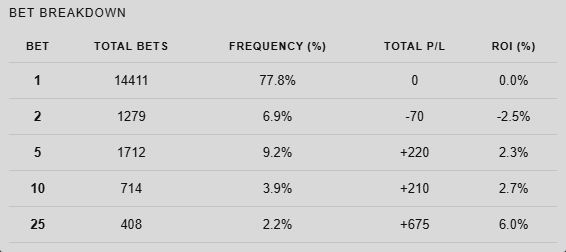
Players increase their bets when the count is high and reduce them when it’s low, using this information to gain a statistical edge over the casino.
So why doesn't everyone do it? Because it's not easy to maintain the count and it is essential to get into the long-term for the edge to materialise.
It's estimated that a player will have at least a 50% chance of being in profit after 1,000 hands. Play 50,000 hands, and that probability jumps to 95%.
- Wonging is a strategy that involves watching a table and only joining the game when the card count is advantageous.
Winning at Blackjack is a brilliant example of a game that can be beaten in the long-run. Give it a go, try a session, and see how you get on!
→ see more at the BETTING SCHOOL